Average Reviews:

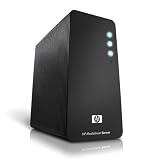
(More customer reviews)The Microsoft Home Server-based HP LX195 MediaSmart was designed to offer the home user 'out of the box' centralized backups of many connected devices as well as central storage facilities for the home's data: music, photos, movies and so on. Its media collector can be set to periodically check the connected computers and copy newly found media files to the server. The built in media servers would allow devices not specifically connected to the MediaSmart such as a PS3 or Xbox 360 to access and play the server's Music, Photo and Movie stores. The iTunes server will stream music and playlists to computers that are running iTunes or to compatible devices. In addition, there is an interface to allow for publishing one's photos to sites such as Google's Picassa or one's flickr page or Facebook account. The Windows Media Center connector allows clients with Windows Media Center installed to play music, videos and recorded TV stored on the home server. When properly setup, backups are possible externally on Amazon's S3 cloud (a paid service) and, with proper setup, the server could be managed and server's media files could be set to be accessible from the Net.
After the initial setup, the backup and media streaming services can be made available to Mac clients.
The MediaSmart's initial one-disk, 640GB storage capacity can be expanded by attaching up to 4 additional disk drives via USB ports. Once more than one disk is available, the media folders can be 'duplicated' to allow for data redundancy in the event of an accident. BRIEF EVALUATION:
In my view, this specific model, while attempting to strike a balance between features and ease of operation/simplicity, it comes short of expectations, to various degrees, on both ends - the end product may not appear to be easy to setup to 'the average user' and it's not always easy to use while most of the services offered don't have sufficient flexibility in fine-tuning via the simple interfaces provided.
But, here are the goods and the bads:
(good)
+ Backups, once the setup is complete do work
+ Easy maintenance
+ Server appears to recover nicely from minor incidents and outages
+ Disk expansion via USB ports is as easy as plugging the disk in
+ Once one or more disks are added, folder duplication does protect the data
+ No bloatware. The only 'free trial' third party is the McAffee Total Protection service but it's an optional install and it does not pop up every time the home server is accessed
+ Automatic Windows update for the Home Server operating system is easy to set up
+ Expandable functionality through Additional add-ons installations
+ Both the Windows Home Server online Help facility/manual and the MediaSmart manual are very well written(bad)
- somewhat underpowered with an Atom one-core CPU and 1GB RAM.
- 640GB is insufficient storage for a machine that's supposed to back up 'everything'
- the out-of-the-box one-disk architecture puts data at risk
- the only officially documented server expansion is additional disks but memory expansion, while not documented, should be possible
- some difficulties can be encountered during the initial installation and setup
- installation and setup does not allow for a lot of flexibility
- a little awkward access to media files from registered clients - require a separate account setup even when 'read only' data is accessed
- direct access to the Microsoft Home Server OS is labeled as risky - warning states that the OS COULD break if the native interface is usedTo be fair, once the initial setup completes, the server will operate more or less trouble-free for as long as the home network does not change in any dramatic fashion. The lack of flexibility can be addressed to some extent if one is willing to access and 'play' with each of the client machines configurations and access and tweak the Windows Home Server operating system directly but then the 'ease of setup' claim would have to be abandoned.MY EXPERIENCE:
My own server installation, setup, operation and use can be summarized as follows:
- Initial setup required significant changes at the server's own TCP/IP configuration and each of the client PC's. All was well documented in the 250-page manual but I did have to set up a static IP for the server, modify the HOSTS file on each PC, register several installed apps with the Windows Firewall.
- Centralized backups were easy to configure but the options are few. The software decides by itself which folders should be excluded and there is no way to take them off the list. The only option is to add some more folders. The schedule can be configured for the server to retain the desired number of monthly, weekly and daily backups. The daily backups are incremental and they complete within minutes. The initial backup, depending on what network you are, can take many hours. It took hours for my computers in a 56Mps (about 6MB per second) wireless setting. Interestingly, the backup utility has the ability to 'wake up' a computer that's put to 'sleep' or 'hibernate' and, more often than not, it was able to put the machine back to sleep once the backup was finished.
- The lack of flexibility makes the media collector, even when it works, not worth using. As far as data collection it has only 2 options: either a specific and preset collection of folders for the various type of media wherethe files are more likely to be found - like 'My Music' for music - or 'all folders'. After testing the collection on 3 machines I found that on one it found a lot of 'stuff' that I didn't want found - little picture files associated with some software installations - while on another it found nothing even when I selected 'all folders'. I suspect something having to do with my setup but I decided to give up and I manually copied the media that I wanted on the server.
- Surprisingly, one device that benefits the most seems to be our PS3 which picked up and was able to take advantage of the Media Server even before I was finished with the server setup. Even more surprisingly, no authentication was requested from the PS3 even though it was playing the same files that required an account and a password if I wanted to access them from my own computer.
- Central stores for media files is a useful feature, especially when the folder duplication is activated.
- The ability to publish photos to sites such as Picasa, flickr or Facebook works but, in the case of Picasa, which I tested, the task can be accomplished better with Picasa's own interface which provides a lot more flexibility.
- Storage expansion is easy but, again, not sufficient flexibility. The first disk I plugged in had a FAT32 partition and a larger NTFS partition. My expectation was for the server to ignore the FAT32 and use the NTFS but, to my surprise, not only it reformatted the disk but it actually re-partitioned it and produced an NTFS-only, one-partition drive. Just to make it clear, it did tell me that it was going to reformat and repartition my disk before it proceeded to do so.
- Self diagnostic and recovery seem to be satisfactory for minor glitches but, not sufficient information is available for more difficult troubleshooting unless one goes to the operating system. Unplugging the server did not damage it. Unplugging the attached disk created a number of errors and suggestions on how to fix them but, once the disk was plugged back in, the server became healthy again within minutes and, to my surprise, all the notifications simply disappeared as if there was never a problem.
- With a Wireless-G router, providing 56Mbs, music streaming went well on the PS3. The PS3 immediately recognized the media server and it played the music.
- Photo viewing was so-so on the internal network. Could see individual pictures but playing slide-shows with 3-5MB individual picture files was a little slow and choppy.
- Video streaming was not acceptable at all but I suspect it would have been okay if I had a 'wired' home network.
- I decided not to try remote access at this time because I had no compelling reasons to do so.RATING:
- 3.5 Stars for INSTALLATION AND SETUP. The server does not normally install itself but a lot of the complication is attributable to the complexities of a home's network environment. I expect for real users to report anything from "it installed within minutes and I didn't have to do a thing" to "I spent many hours with the HP Help Support and now I'm returning it because they couldn't help me." It would have be nice if the printed version of the 200+ page manual was included in the box.
- 2.0 Stars for DESIGN AND ARCHITECTURE. I understand cost constraints issues but to sell a home SERVER with only one disk and a rather small one at that was not a wise decision. This is supposed to be sold to the 'average' home users and this makes it worse because it's the average users who do not understand that their data is NOT fully protected this way.
- 3.0 Stars for PERFORMANCE. One Atom processor, one small disk (for a server) and only 1GB of memory do not assure me that the server will continue to perform adequately if and when more add-ons are installed. It gets 3 stars because it performs well at this time.
- 4.0 Stars for EASE OF USE, once configured. The server administration is easy for as long as one doesn't forget the server's password. Most quirks are minor and, once configured, the server pretty much runs itself.
- 3.0 Stars for CONFIGURABILITY. This has to do with the frustrating scarcity of options on services such as backups or media collection. I agree that most of the bases are...Read more›
Click Here to see more reviews about: HP LX195 MediaSmart Home Server
Product Description:
Automatically back up and protect your digital memories, centralize your media and content for sharing with friends and family, and enjoy your digital media while at home or away with the HP LX195 MediaSmart Home Server. The LX195 is the first HP MediaSmart to be powered by the efficient Intel Atom processor, which helps use less energy and save you money on your electrical bills. A Sleep Mode conserves energy and saves you money in more ways than one. The built-in sleep mode consumes only 3W of power, and the server can take on many of your PC's responsibilities, enabling you to turn off your individual computers to further save energy and money.
Enjoy both worry-free backup of all of your home's PCs (including Macs) as well as easy music, video and photo streaming.
The HP LX195 includes 640 GB of internal storage and expansion using USB external hard drives via the four USB 2.0 ports. The sleek, slim micro-tower design is perfect for use in the home office or the living room, and it has a compact footprint of just 4 by 8 inches. The LX195 includes a single internal hard drive with 640 GB of storage, and you can expand your storage capabilities via optional external USB drives, which can connect via the four USB 2.0 ports on the back of the device. Other features include 1 GB of RAM, and ultra-fast Gigabit Ethernet networking (10/100/1000). And it's easy to set up--just plug it in, connect it to your wireless router (sold separately), and load the software onto your PCs and Macs.
Managing Your Digital Lifestyle
With the increasing amount of digital content that you work with on a daily basis as well as growing digital media libraries, a homer server can both share files to computers on your network as well as back up critical files from those computers. Here are just a few things that the HP LX195 MediaSmart can do for you:Automatic Backup
Automatically manage daily backup, virus protection, media collection, and power management, all behind the scenes.
Automatically back up multiple computers, whether running Windows (via Microsoft Windows Home Server Backup) or Mac (via Apple Time Machine).
Store up to 168,000 photos, 147,000 songs or 405 hours of video on the installed 640 GB hard drive.
Get additional protection by backing up your server to an on-line back-up service like Amazon S3.
Designed for Digital Media
Access your media anywhere with an Internet-connected computer.
Stream music and photos to any computer, while you're at home or away.
Stream to your stereos and TVs through a gaming console like the Xbox 360 or PlayStation3.
Publish photos to photo-sharing and social networking Web sites--Snapfish, Flickr, Picasa, and even Facebook--via any Internet-connected computer, or share directly from your server.
Share music libraries for play throughout your home.
Easy Setup, Scheduling, and Support
Set up fast: just plug it in, connect it to your wireless router (sold separately), and load the software on your PCs and Macs.
Schedule the server to copy and centralize Windows PC media files and libraries (including iTunes and playlists).
Expand your capacity by adding external hard drives via four USB ports on the back.
Warranty and support: one-year limited; get help toll-free, 24 x 7, or via email in as little time as an hour.
Software Features
HP Control Center. The HP MediaSmart software that sits on top of the Windows Home Server software making access to tasks easier. Users with administrative access privileges can access the Windows Home Server Console from the HP Control Center.
Windows Home Server Console. Software accessed from the HP Control Center to manage your HP MediaSmart Server. Software includes setting up shared folders, assigning user access privileges and customizing backups.
File Sharing and Storage. Effortlessly centralize your files and access them from any PC and or Mac on your home network. Set Read/Write, Read Only or No Access privileges for each user. Access privileges are set at the shared folder level. In addition, you control the remote access privilege for each user.
PC Hard Drive Disk Backup. Once the HP MediaSmart Server software is installed on a home PC, the Windows Home Server backup software automatically starts backing up the PC's hard disk drive image every night. You can customize the number and frequency of backups kept. You can also make incremental backups, where only changes are backed up after the initial large backup.
Mac Backup. Back up your Macs to the MediaSmart Server using Apple's Time Machine software.
Shared Folder Duplication. Folder duplication requires permanently adding an external hard disk drive to one of the USB 2.0 ports on the back of the product. Designated folders can be copied automatically onto an external hard disk drive for an additional layer of redundant protection.
HP Media Collector. Conveniently schedules the server to copy and centralize your Windows PC media files and libraries (including iTunes and playlists).
Remote Access. Upon installation, you can set up a personal web address to be used for remote access and by visitors. Using your personal web address, you can remotely access shared folders and files on the HP MediaSmart Server from any Internet-connected computer. Remotely run applications on computers on your home network through the HP MediaSmart Server from an Internet-connected computer using your personal web address.
In-Home and Remote Media Streaming. Extend your digital media experiences by conveniently streaming photos, music and videos to your TVs, through gaming consoles such as Xbox 360 or PlayStation3, and computer's within your home. Remotely stream music and photos from your server to any Internet-connected computer for access while you are away.
HP Photo Publisher. Easily publish your photos to Snapfish, Facebook, Flickr, and Picasa Web Albums using an Internet-connected computer
HP Photo Viewer. Quickly share photos and albums stored on the Server with friends and family.
Server for iTunes. Centralize your iTunes music libraries and playlists on the server for playback to any PC or Mac running iTunes on your home network.
Easy Storage Expansion. Add up to four external hard drives to the HP MediaSmart Server, indicate that you want to add the disk in the Windows Home Server Console, and the HP MediaSmart Server storage grows. No need to power down the unit or manage drive letters for multiple hard drives.
Server Anti-Virus Protection. Server side anti-virus trial offer from McAfee for increased protection of your HP MediaSmart Server. Run quick scans of specific folders or deep scans across your entire home server.
Server Backup.
Users. Up to 10 user accounts can access the HP MediaSmart Server. In addition, a predefined Guest account can be enabled.
PC Operating System Support:
Automatic backup of computers running Microsoft Windows Vista (32 & 64 bit), XP Home (SP2), XP Professional (SP2), Media Center Edition 2004 (SP2) or later, and Macs running Apple'sTime Machine.
File sharing for computers running Microsoft Windows Vista (32 & 64 bit), XP Home (SP2) or XP Professional (SP2), Media Center Edition 2004 (SP2) or later, Mac OS X, or Linux.
Remote access to computers running Microsoft Windows XP Professional (SP2), Media Center Edition 2005 (SP2), or Vista Ultimate.
Hardware Features
Processor: 1.6 HGz Intel Atom 230
Memory: 1 GB of DDR2 RAM
Internal Storage: 640 GB hard disk drive (SATA, 7200 RPM)
Internal Expansion: none
External Expansion: 4 USB 2.0
Network Support: 10/100/1000 (Gigabit) RJ45 Ethernet; supports both wired and wireless PCs (via a wireless router).
Dimensions: 3.9 x 8.2 x 8 inches (WxHxD)
What's in the Box
This package includes the HP LX195 MediaSmart Server, power adapter and cable, Ethernet cable, software installation disc, PC restore disc, server recovery disc, and printed setup and user guides. The MediaSmart Server is backed by a one-year limited warranty and dedicated software technical support both online and by phone.
 Get 30% OFF
Want to read more honest consumer review about HP LX195 MediaSmart Home Server now ?

0 comments:
Post a Comment